
Rosalind Franklin
British chemist, biophysicist, and X-ray crystallographer
Born:July 25, 1920
Died:April 16, 1958
Age at death:37
Manner of death:Natural Causes
Cause of death:Ovarian Cancer
Zodiac Sign:Leo
Born in:Notting Hill, United Kingdom
Buried in:United Kingdom
Languages:English, British English, French
Links
Awards
Rosalind Franklin
British chemist, biophysicist, and X-ray crystallographer
Biography
This biography uses content from the Wikipedia article “Rosalind Franklin”, available under the Creative Commons Attribution-ShareAlike 4.0 License.
Quotes
“Science and everyday life cannot and should not be separated.”
— in answer to her father, who accused her of making science her religion, as related by Brenda Maddox (2003). Rosalind Franklin: The Dark Lady of DNA. Perennial. p. 61. ISBN 0060985089.
“What’s the use of doing all this work if we don't get some fun out of this?”
— As quoted by Aaron Klug, interview , 17 June 2005 [1]
“The results suggest a helical structure (which must be very closely packed) containing 2, 3 or 4 co‐axial nucleic acid chains per helical unit, and having the phosphate groups near the outside.”
— Notes from November 1951 about Franklin's electron microscopy imaging of DNA, which led to Watson & Crick's publication of the structure of DNA by sixteen months. As quoted in How Rosalind Franklin Discovered the Helical Structure of DNA: Experiments in Diffraction (in The Physics Teacher 49, 140 (2011); doi: 10.1119/1.3555496), quoting Rosalind Franklin and DNA (2000), page 15.
Quotes sourced from the Wikiquote article "Rosalind Franklin", available under the Creative Commons Attribution-ShareAlike 4.0 License.
Photos
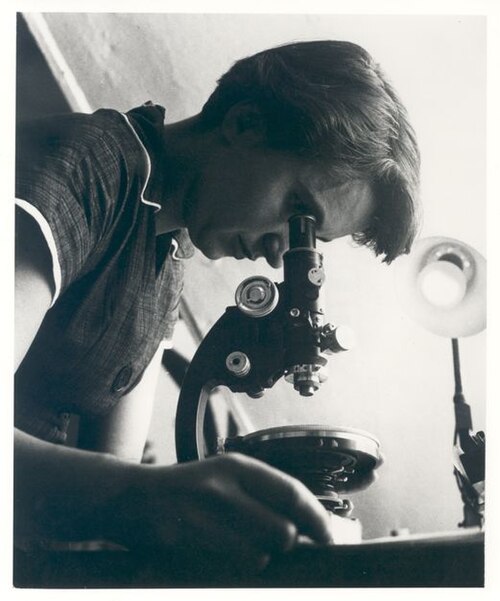
Rosalind Franklin with microscope in 1955.
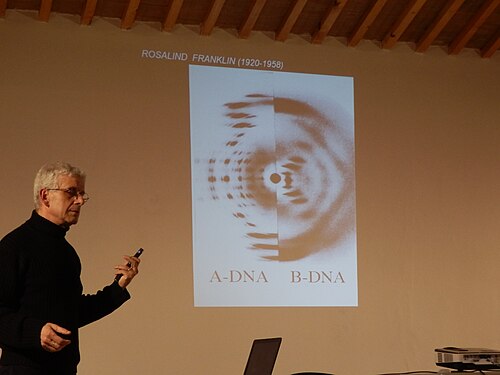
Porfessor Claudio Pugliesi, lezioni presso l'auditorium di Villa Pertusati (Museo di Storia Naturale di Rosignano Marittimo), ciclo di conferenze "Parliamo di scienza 2019"
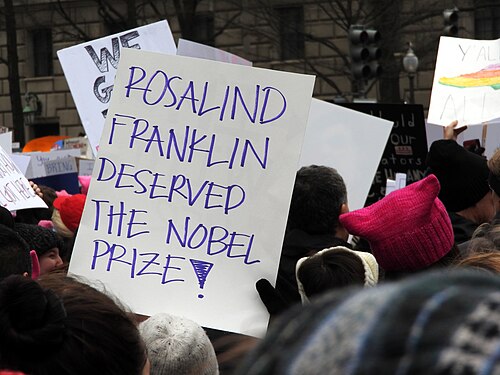
I did my part by explaining this to someone next to me who was puzzled.
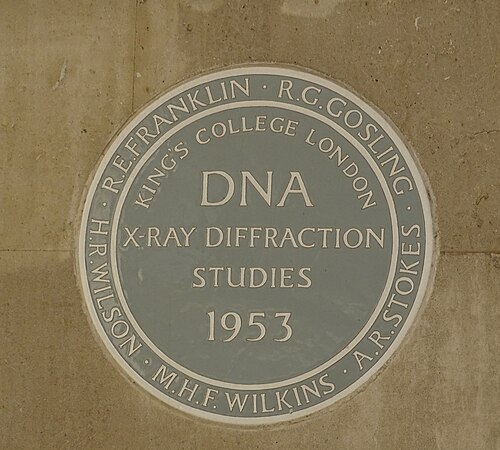
Memorial plaque for Rosalind Franklin and her team for their DNA-studies, King's College London, The Strand Building, London;
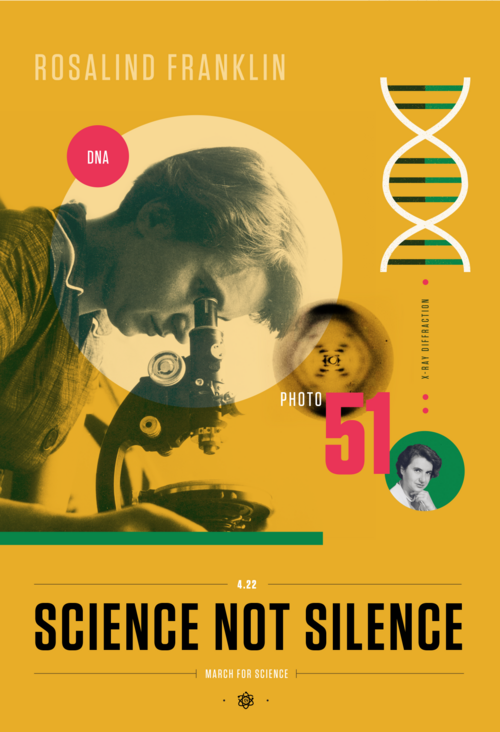
Rosalind Franklin is one of the women featured in Beyond Curie - a portrait series of women in STEM. She took a picture of DNA, Photo 51, that changed our understanding of the structure of DNA. Snubbed for the Nobel Prize in 1962, Her story is one of the most well-known and shameful instances of a researcher being robbed of credit. Let's celebrate her now.
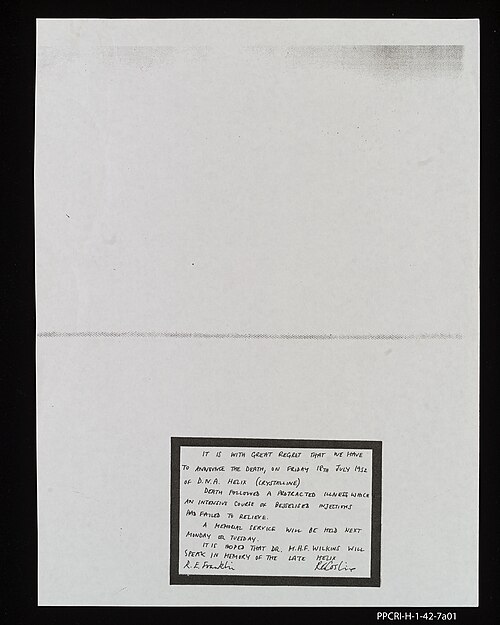
A satirical note, in the style of an in memoriam card, sent to Maurice Wilkins and signed by Franklin and Gosling, with the following text (holograph, Franklin's hand): "It is with great regret that we have to announce the death, on Friday 18th July 1952[,] of DNA helix (crystalline). Death followed a protracted illness which an intensive course of Besselised injections had failed to relieve. A memorial service will be held next Monday or Tuesday. It is hoped that Dr M H F Wilkins will speak in memory of the late helix." The text refers to the 'A' form (low humidity) of DNA. The card is reproduced in Brenda Maddox, Rosalind Franklin: The Dark Lady of DNA (2002), p. 185. Archives & Manuscripts Keywords: Genetics; Francis Harry Compton Crick; DNA; Maurice Hugh Frederick Wilkins; R. G. Gosling; Rosalind E. Franklin
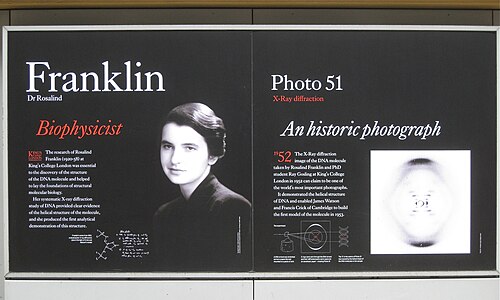
Dr Rosalind Franklin and Photo 51
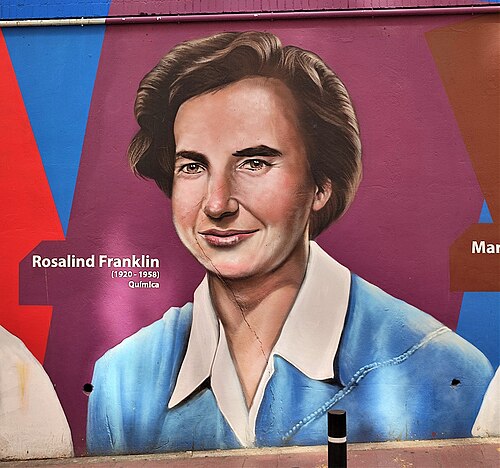
Rosalind Franklin representada al mural Pioneres, Hospital de la Vall d'Hebron
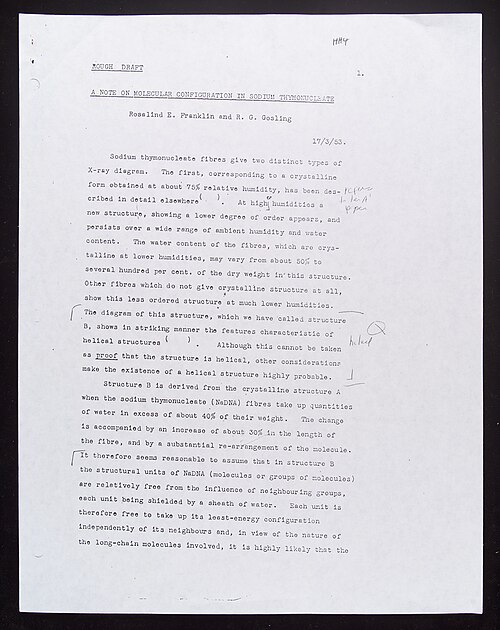
A Note of Molecular Configuration in Sodium Thymonucleate. Rough Draft by Rosalind E. Franklin and R. G. Goslinh. Page 1 Archives & Manuscripts Keywords: DNA
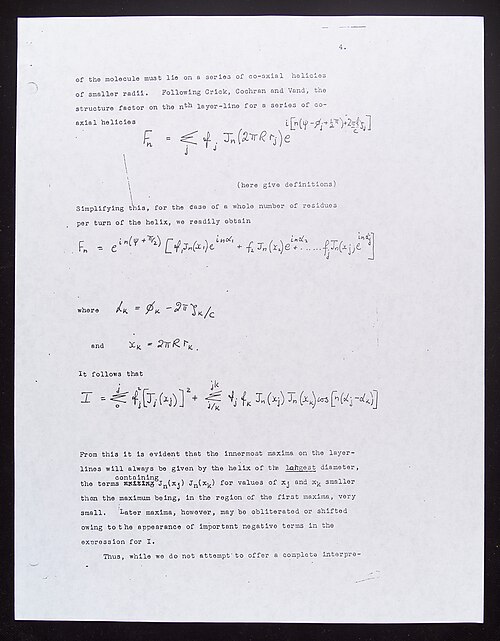
A Note of Molecular Configuration in Sodium Thymonucleate. Rough Draft by Rosalind E. Franklin and R. G. Goslinh. Page 4 Archives & Manuscripts Keywords: DNA