
George III of Great Britain
King of Great Britain and Ireland from 1760 to 1820

Born:June 4, 1738
Died:January 29, 1820
Age at death:81
Manner of death:Natural Causes
Cause of death:Disease
Zodiac Sign:Gemini
Children:15
Born in:Norfolk House, United Kingdom
Buried in:United Kingdom
Languages:German, English
Signature

Related People
Famous For
Books
Awards
George III of Great Britain
King of Great Britain and Ireland from 1760 to 1820
Biography
This biography uses content from the Wikipedia article “George III of Great Britain”, available under the Creative Commons Attribution-ShareAlike 4.0 License.
Quotes
“The pride, the glory of Britain, and the direct end of its constitution, is political liberty.”
— Essay (late 1750s), quoted in John Brooke, King George III (1972; 1974), p. 108
“[Freedom of speech] is not only the natural privilege of liberty but also its support and preservation, every man therefore here is allowed to declare his sentiments openly, to speak or write whatever is not prohibited by the laws.”
— Essay (late 1750s), quoted in John Brooke, King George III (1972; 1974), p. 108
“We may therefore infer from this long reign that this people will never refuse anything to a sovereign who they know will be the defender of their liberties.”
— Essay on Edward III of England (late 1750s), quoted in John Brooke, King George III (1972; 1974), p. 110
Quotes sourced from the Wikiquote article "George III of Great Britain", available under the Creative Commons Attribution-ShareAlike 4.0 License.
Photos
George III of the United Kingdom
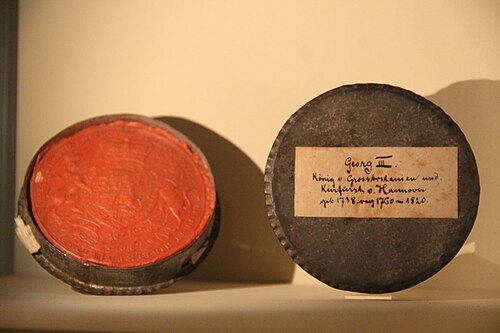
035.000 Kloster Isenhagen Museum Wachssiegel mit Blechdose
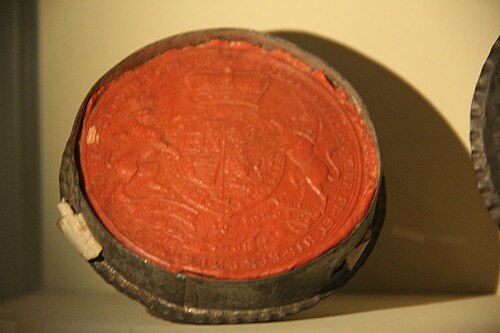
035.000 Kloster Isenhagen Museum Siegel
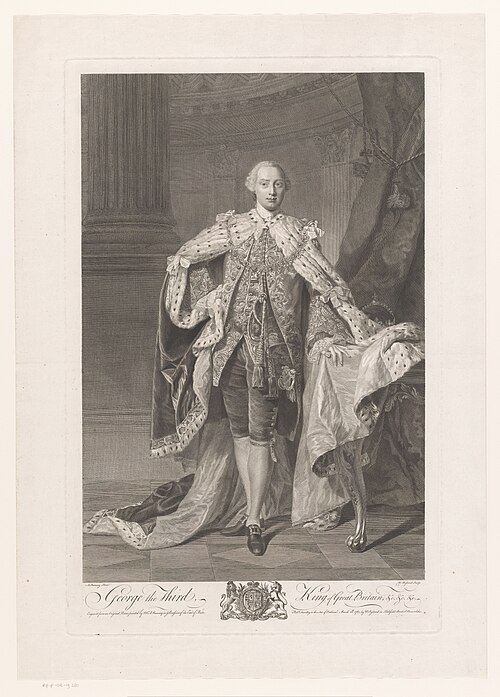
Identificatie Titel(s): Portret van George III van het Verenigd Koninkrijk George the Third, King of Great Britain, &c. &c. &c. (titel op object) Objecttype: prent Objectnummer: RP-P-OB-19.280 Opschriften / Merken: verzamelaarsmerk, verso, gestempeld: Lugt 2228 Vervaardiging Vervaardiger: prentmaker: William Wynne Ryland (vermeld op object), naar schilderij van: Allan Ramsay (vermeld op object), uitgever: William Wynne Ryland (vermeld op object) Plaats vervaardiging: Londen Datering: mar-1761 Materiaal en Techniek Materiaal: papier Techniek: etsen Afmetingen: plaatrand: hoogte 590 mm × breedte 381 mm Onderwerp Wat: king, historical persons Wie: George III (koning van het Verenigd Koninkrijk) Verwerving en rechten: Verwerving: onbekend 2006 Copyright: Publiek domein

A lock of hair, reputedly from King George III King George III (1738-1820) ruled the United Kingdom of Great Britain and Ireland and was also king of Hanover – part of mainland Europe – from 1760 to 1820. He was prone to episodes described as ‘madness’ by contemporaries. Recent tests on the hair found an unexpectedly high concentration of arsenic. Heavy metals such as arsenic can make the symptoms of the hereditary condition called porphyria worse. Some researchers believe George had this condition. Porphyria can lead to severe mental imbalance and episodes of apparent ‘madness’. Other symptoms include abdominal pain, dislike of bright light, and purple urine. Henry Wellcome bought this lock of hair at auction in 1927, enclosed within a slip of paper documenting its origin. Medical Photographic Library

A lock of hair, reputedly from King George III King George III (1738-1820) ruled the United Kingdom of Great Britain and Ireland and was also king of Hanover – part of mainland Europe – from 1760 to 1820. He was prone to episodes described as ‘madness’ by contemporaries. Recent tests on the hair found an unexpectedly high concentration of arsenic. Heavy metals such as arsenic can make the symptoms of the hereditary condition called porphyria worse. Some researchers believe George had this condition. Porphyria can lead to severe mental imbalance and episodes of apparent ‘madness’. Other symptoms include abdominal pain, dislike of bright light, and purple urine. Henry Wellcome bought this lock of hair at auction in 1927, enclosed within a slip of paper documenting its origin. Medical Photographic Library
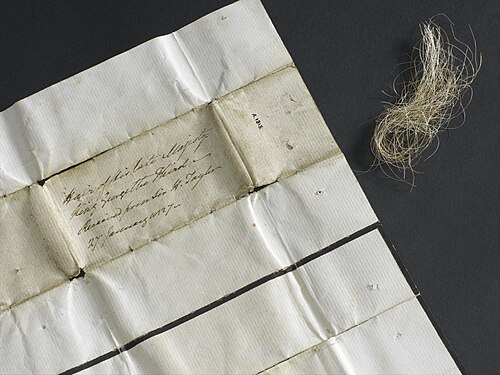
A lock of hair, reputedly from King George III King George III (1738-1820) ruled the United Kingdom of Great Britain and Ireland and was also king of Hanover – part of mainland Europe – from 1760 to 1820. He was prone to episodes described as ‘madness’ by contemporaries. Recent tests on the hair found an unexpectedly high concentration of arsenic. Heavy metals such as arsenic can make the symptoms of the hereditary condition called porphyria worse. Some researchers believe George had this condition. Porphyria can lead to severe mental imbalance and episodes of apparent ‘madness’. Other symptoms include abdominal pain, dislike of bright light, and purple urine. Henry Wellcome bought this lock of hair at auction in 1927, enclosed within a slip of paper documenting its origin. Medical Photographic Library
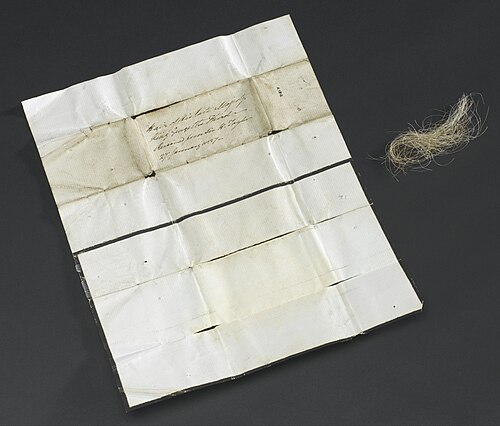
A lock of hair, reputedly from King George III King George III (1738-1820) ruled the United Kingdom of Great Britain and Ireland and was also king of Hanover – part of mainland Europe – from 1760 to 1820. He was prone to episodes described as ‘madness’ by contemporaries. Recent tests on the hair found an unexpectedly high concentration of arsenic. Heavy metals such as arsenic can make the symptoms of the hereditary condition called porphyria worse. Some researchers believe George had this condition. Porphyria can lead to severe mental imbalance and episodes of apparent ‘madness’. Other symptoms include abdominal pain, dislike of bright light, and purple urine. Henry Wellcome bought this lock of hair at auction in 1927, enclosed within a slip of paper documenting its origin. Medical Photographic Library

Sujet : Angleterre (GB) Grande-Bretagne Appartient à l’ensemble documentaire : MonnAng Langue : latin

Sujet : Angleterre (GB) Grande-Bretagne Appartient à l’ensemble documentaire : MonnAng Langue : latin