Edward I of England
King of England from 1272 to 1307

Born:June 18, 1239
Died:July 7, 1307
Age at death:68
Manner of death:Natural Causes
Cause of death:Dysentery
Zodiac Sign:Gemini
Height:1.88 m (6′2″)
Born in:Palace of Westminster, United Kingdom
Buried in:United Kingdom
Languages:English
Related People
Links
Famous For
Books
Edward I of England
King of England from 1272 to 1307
Biography
This biography uses content from the Wikipedia article “Edward I of England”, available under the Creative Commons Attribution-ShareAlike 4.0 License.
Quotes
“The laws the Irish use are detestable to God, and so contrary to all law that they ought not to be deemed law.”
— Speech (1277), quoted in Marc Morris, A Great and Terrible King: Edward I and the Forging of Britain (2009), p. 220
“The land of Wales was before subjected to the King by the feudal law.”
— Statute of Rhuddlan, 10 Edw. I (1284). J. W. Jones, A Translation of all the Greek, Latin, Italian, and French Quotations which occur in Blackstone's 'Commentaries on the Laws of England', &c. (London, 1823) p. 19
“When you get rid of a turd, you do a good job.”
— Remark upon appointing John de Warenne, 6th Earl of Surrey as Guardian of Scotland (1296), attributed to Edward in the Scalacronica, quoted in Michael Prestwich, Edward I (Yale University Press, 1997), p. 477
Quotes sourced from the Wikiquote article "Edward I of England", available under the Creative Commons Attribution-ShareAlike 4.0 License.
Photos
A carved head of King Edward I on the chancel arch of Holy Rood at the Lawns, Swindon.
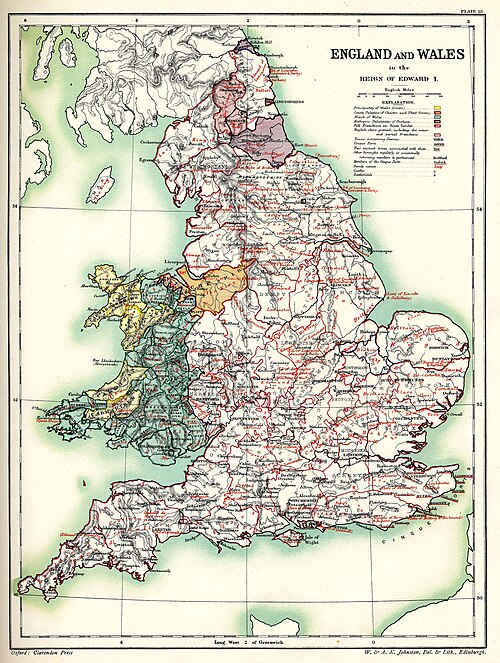
Map of England and Wales under Edward I of England (i.e. 1272-1307)
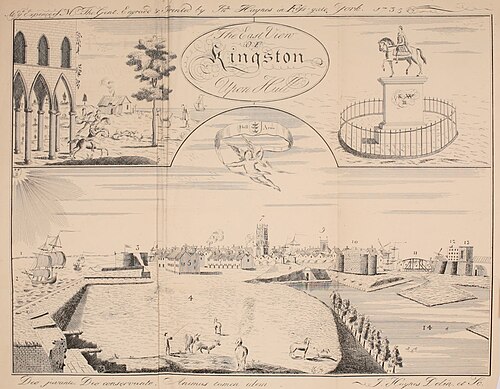
Engraving by Haynes (?) of Fossgate (?) York From "History of Hull" - "East Prospect of the Royal Town of Kingston upon Hull" - after contents before chapter 1 - description of plate: (quoted verbatim from source) AT the Top, on the Left Hand, is a Representation of Part of an old Monastery, as supposing it to have been Meaux Abbey ; because from the Abbot of that Place, the Royal Founder King Edward the First purchased the Ground where Kingston-upon-Hull now stands : The King is also portray'd as hunting with his Nobles, &c. On the Right Hand is delineated the Effigy of King WILLIAM III. of Ever-Glorious Memory. Beneath is the Prospect of the Town itself : And the Figures 1, 2, 3, &c. interspers'd here and there, denote the following Particulars, viz. 1. Part of Lincolnshire. 2. HUMBER. 3. South Block-House. 4. The Garrison. 5. Governour's House. 6. Soldiers Barracks. 7. H. Trinity Church. 8. Old Guard House. 9. St. Mary's Church. 10. The Magazine. 11. North-Bridge. 12. Sugar-House. 13. Drypool Church. 14. New-Cut.

Letter from King Edward I to the Sheriff of Gloucester, dated 18 July 1290 concerning the expulsion of the Jews from England The King to the sheriff of Gloucester etc. Whereas the king has prefixed to all the Jews of his realm a certain time to pass out of the realm; he wills that they shall not be treated by his ministers or others otherwise than has been customary. He orders the sheriff to cause proclamation to be made throughout his bailiwick prohibiting any one from injuring or wronging the Jews within the said time. He is ordered to cause the Jew to have safe conduct at their cost when they, with their chattels, which the king has granted to them, direct their steps towards London in order to cross the sea, provided that before they leave they restore the pledges of Christians in their possession to those to whom they belong. Witness the king at Westminster, 18th July. The like to the sheriffs of Essex, York, Northampton, Lincoln, Hereford and Southampton.

Letter from King Edward I to the Treasurer and Barons of the Exchequer, dated 5 November 1290 Edward, etc. To the Treasurer and Barons of the Exchequer, greeting. Whereas the king in his parliament at Westminster at the quinzaine of Michaelmas in the third year of his reign, ordained that no Jew of the realm should thenceforth lend anything in usury to any Christian upon lands, rents or other things, but should earn his living by trade and labour, and the Jews afterwards, maliciously discussing amongst themselves, changed the kind of usury into a worse kind, which they called courtesy, and oppressed the king’s people twice as bad as before; as a result the king, for this reason and for the honour of Christ, has caused the Jews to leave his realm as perfidious men

Reconstitution of Edward I of England apartments at the Tower of London

Identifier: cu31924027975121 (find matches) Title: Essentials in English history (from the earliest records to the present day) Year: 1905 (1900s) Authors: Walker, Albert Perry, 1862-1911 Hart, Albert Bushnell, 1854-1943 Subjects: Publisher: New York, Cincinnati (etc.) American book company Contributing Library: Cornell University Library Digitizing Sponsor: MSN View Book Page: Book Viewer About This Book: Catalog Entry View All Images: All Images From Book Click here to view book online to see this illustration in context in a browseable online version of this book. Text Appearing Before Image: would often set free aportion of their serfs, either as penance for sacrilege or someworse crime, or upon their deathbeds, as a preparation fordeparture from life. Villeins might earn their own enfranchisement, since suchof them as had a talent for handicrafts were able during theirfree hours to earn enough silver to commute their dues 147. En-in kind into a money payment, an exchange which the lord jj^^^^^f ^jiwas always glad to make. They were then able to devote leins all their time to their wage-earning crafts, and speedily becamefree tenants. Others, shrewd in purqhasing and bargaining,bought their freedom with the proceeds of trade. Manystrong-willed villeins fled from their manor and took refuge insome distant town, where, by customary law, a residence of ayear and a day freed them from their bondage to the soil ofthe manor whence they had fled. A still more important 141 PLANTAGENET ENGLAND DIVISIONS IN THE TIME OF EDWARD SCALE OP MILES 5 W W 3o i3o oXxC Palatine CouBties S E Text Appearing After Image: T&JHI. ^NiftH. OF WIGHT i r s H UUnATES, eNGR, N:r. i Longitude West 2 from Greenwich 0 East 143 ANCJI ECONOMIC AND SOCIAL PUOGUESS (1100-1350) 143 means of rising in the world lay through entrance into holyorders; for the church was ready to seek everywhere, in thevilleins cottage as in the lords manor house, for intelligent,devoted servants. As with individuals, so with communities. Places which,like Chester and Carlisle, were located near some old Romanor Norman stronghold; others which, like Oxford orAVinchester, were the sites of important monasteries; of char-and others which, like Norwich, stood at the head of °^^^ navigation on some stream, attracted to themselves the carpen-ters, masons, glass and metal workers, for whom the Normansnow found employment. Villages developed rapidly intotowns through the growth of trade, and as soon as they wererich enough they sought charters of privileges from their t Beginning of a Charter of Henry III., granting a Guildhall to Oxford.! Note About Images Please note that these images are extracted from scanned page images that may have been digitally enhanced for readability - coloration and appearance of these illustrations may not perfectly resemble the original work.

SC 8-309-15406 -Petition of Darnhall villagers to King Edward I, 1275. from The National Archives, Kew. Latin.

A tally for 6s 8d issued by the Treasurer of Edward I to the Sheriff of Lincolnshire. Illustration from Medieval London by Sir Walter Besant, published in 1906.
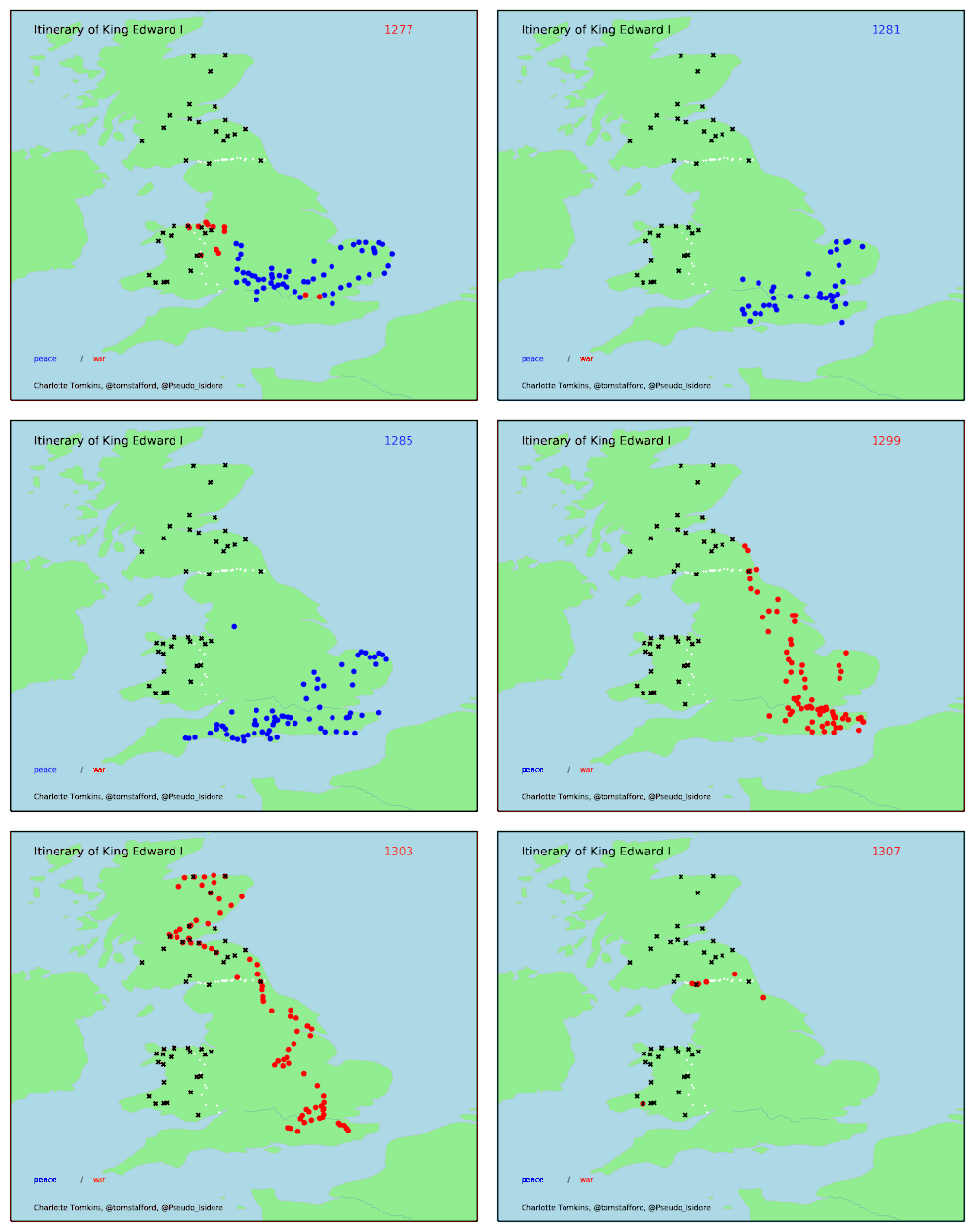
A gif showing King Edward I's movements around Britain and France. Black crosses mark Edwardian castles.