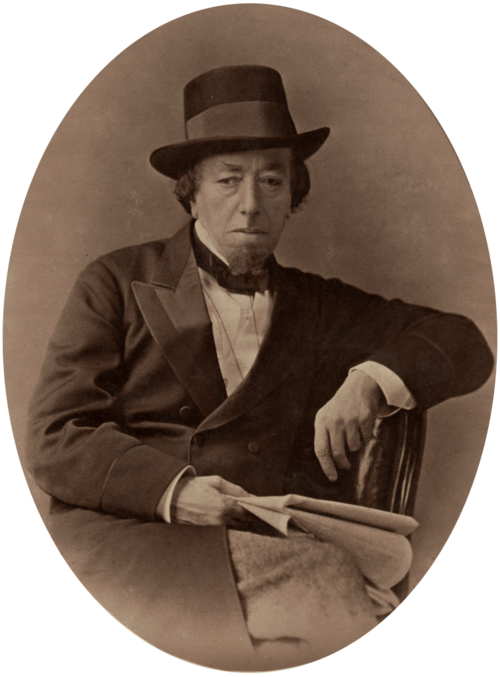
Benjamin Disraeli
British statesman
Born:December 21, 1804
Died:April 19, 1881
Age at death:76
Zodiac Sign:Sagittarius
Born in:London, United Kingdom
Buried in:United Kingdom
Languages:English
Signature

Links
Famous For
Notable Work
Books
Awards
 Fellow of the Royal Society
Benjamin Disraeli
British statesman
Biography
This biography uses content from the Wikipedia article “Benjamin Disraeli”, available under the Creative Commons Attribution-ShareAlike 4.0 License.
Quotes
“Coningsby (1844)”
“Sybil, or The Two Nations (1845).”
“Cathedral High Mass. Clouds of incense and one of Mozart's sublimest masses by an orchestra before which San Carlo might grow pale. The effect inconceivably grand. The host raised, and I flung myself on the ground.”
— Diary entry while in Ghent (1 August 1824), quoted in William Flavelle Monypenny and George Earle Buckle, The Life of Benjamin Disraeli, Earl of Beaconsfield. Volume I. 1804–1859 (1929), p. 49
Quotes sourced from the Wikiquote article "Benjamin Disraeli", available under the Creative Commons Attribution-ShareAlike 4.0 License.
Photos
Depicted person: Benjamin Disraeli – British statesman (1804–1881)

The funeral ceremony of the Earl of Beaconsfield in 1881. Wood engraving, 1881. Iconographic Collections
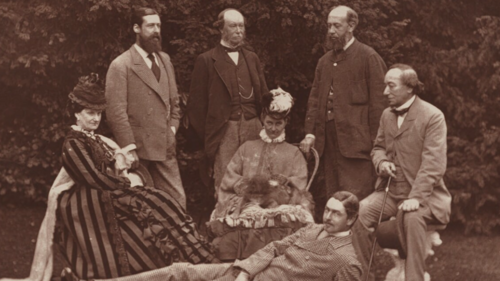
At Disraeli's house Hughenden Manor in 1874 Left to Right: Selina Louisa (née Forester), Countess of Bradford sitting, Montagu William Lowry Corry, Baron Rowton (1838-1903) standing, Orlando George Charles Bridgeman, 3rd Earl of Bradford centre standing, Susan Charlotte (née Lascelles), Countess of Wharncliffe centre sitting, George Robert Charles Herbert, 13th Earl of Pembroke (1850-1895) lying, Edward Montagu Stuart Granville Montagu-Stuart-Wortley-Mackenzie, 1st Earl of Wharncliffe (1827-1899) (standing right and Benjamin Disraeli, Earl of Beaconsfield (1804-1881)
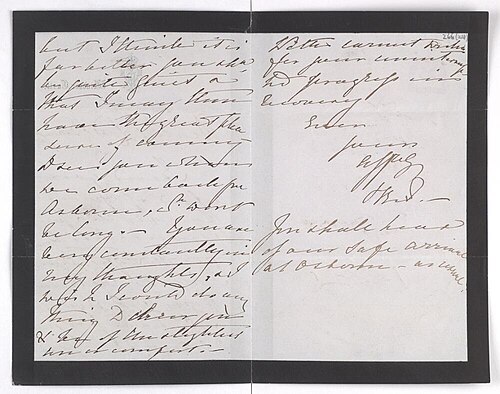
Letter from Queen Victoria, 5 April 1881.; As the author of a runaway bestseller Disraeli purchased a seven-year lease on 19 Curzon Street, W1, in January 1881. It was the first time he had been able to purchase a house with his own money. Curzon Street was the scene of only one dinner party, on 10 March, to which seventeen guests were invited. Disraeli's health was already failing. The east wind cut into him as he made his way home on 22 March. The chill developed into bronchitis and the spiral of decline began. The house soon witnessed a procession of concerned visitors, including his old political rival Gladstone.; Before setting off for Osborne on 5 April she wrote this, her last, letter to Disraeli. It was accompanied by primroses from Windsor and the promise to send more primroses from Osborne. Victoria had thought of going to visit him but considered it better to let him rest and looked forward to seeing him when they returned. 'You are ...constantly in my thoughts, & I wish I could do anything to cheer you.' Disraeli's reputed final reference to Victoria, when asked if he wanted her to be called to his bedside, was 'No, it is better not. She would only ask me to take a message to Albert. Queen Victoria grew concerned. Before setting off for Osborne on 5 April she wrote this, her last, letter to Disraeli. It was accompanied by primroses from Windsor and the promise to send more primroses from Osborne. Victoria had thought of going to visit him but considered it better to let him rest and looked forward to seeing him when they returned. 'You are ...constantly in my thoughts, & I wish I could do anything to cheer you.' Disraeli's reputed final reference to Victoria, when asked if he wanted her to be called to his bedside, was 'No, it is better not. She would only ask me to take a message to Albert.'; At his bedside were Corry, who had returned from accompanying his sick sister to Algeria, Sir Philip Rose, Lord Barrington (Lord Derby's former secretary who was standing in for Corry) and his three doctors: Kidd (a homeopath), Bruce and Quain. His last recorded words were, 'I had rather live but I am not afraid to die'. Just before he slipped into unconsciousness he is said to have stirred, moving forward as he did when rising to speak in Parliament. Disraeli died in the early hours of 19 April on the anniversary of Byron's death. At his bedside were Corry, who had returned from accompanying his sick sister to Algeria, Sir Philip Rose, Lord Barrington (Lord Derby's former secretary who was standing in for Corry) and his three doctors: Kidd (a homeopath), Bruce and Quain. His last recorded words were, 'I had rather live but I am not afraid to die'. Just before he slipped into unconsciousness he is said to have stirred, moving forward as he did when rising to speak in Parliament.; The five-volume anthology, Curiosities of Literature (1791-1834), now in the Library at Hughenden, is probably Isaac's best known work. His other main publication was the five-volume Commentaries on the life and reign of Charles I (1828-30), a topic well-suited to his romantic conservatism. For this study he was awarded a DCL by the University of Oxford in 1832. In addition to these major works Isaac was also the author of several now-forgotten novels and poems.; This letter written on 4 August 1825 from Disraeli to his father describes an evening at a party in Albemarle Street hosted by John Murray for former and current African expeditions. Friendship with Murray would further Disraeli's bookish tendencies and literary talent but founder over disastrous financial collaboration.; Concerned by his son's health Isaac took Disraeli on his first trip abroad, a six-week tour of Belgium and the Rhine in the summer of 1824 accompanied by William Meredith, Sarah's (then) unofficial fiance. The early part of the journey from London to Aix is recorded here. Most of the entries are in pencil and too faint to read with ease, but this description of an attempt to visit Ruben's house in Antwerp on 2 August 1824 gives some indication of Disraeli's enthusiasm for arhitecture - especially churches - paintings, food and landscape, and of his observations on history and local customs. Disraeli didn't keep a diary on the journey's second leg but he did decide to become a writer - and he drew on his experiences in his first novel, Vivian Grey.; Disraeli's debut as a novelist was spectacular. Volume I of Vivian Grey was published anonymously in April 1826. To maximise impact the draft was copied out by Sara Austen to conceal its authorship. Sara, considerably older than Disraeli, was married to his neighbour the lawyer Benjamin Austen, for whom Disraeli had worked. Both Austens were his patrons, she emotionally, he financially. Here she refers to the Star reviewer's comparisons with similar novels like Mathilda and Tremaine, set in 'fashionable' aristocratic society and aimed at middle class readers; the author was a 'lively and accomplished writer' and his 'ingenuity' praised. By July the enthusiasm among high society and reviewers turned to scorn when it was discovered that the satire had been by a youthful onlooker, not an insider.; Disraeli announced to his father his intention of standing for Parliament in this letter written on board HMS Hermes in October 1831 in which he expresses concern that Isaac may not have received his earlier one announcing Meredith's death. Here he notes that his fellow passenger, Henry Stanley, had received a letter in Cadiz that the bill to extend the franchise would be lost - an outcome they could 'barely credit'. When this younger son of the 13th Earl of Derby went missing on arrival in London some of the Stanley family suspected Disraeli of introducing him to a gambling den, an unfortunate development which coloured years of his working relationship with Lord Stanley, the future 14th Earl of Derby, and his predecessor as Conservative Prime Minister.; In this letter Bulwer Lytton sympathises over the loss of Wycombe and encourages Disraeli to consider standing where two candidates could be returned for the same party (as was then possible); after several more unsuccessful attempts Disraeli would be returned in 1837 for just such a constituency: Maidstone. Disraeli greatly valued Bulwer's intellectually stimulating friendship. The satirical Xion in Heaven, published in Bulwer's New monthly magazine in December 1832 and February 1833, is considered one of Disraeli's most original works.; In the summer of 1833 Disraeli met Sir Francis and Lady Sykes (d. 1846) and shortly afterwards began an affair with Henrietta. Sir Francis's property included Basildon Park in Berkshire (now a National Trust property), a setting for Henrietta Temple, the novel inspired by the affair and the pressing need to settle debts. Henrietta was aristocratic and sensuous and, as the references to 'A mother's kiss' (and 'your faithful and fond love') indicate, capable of meeting Disraeli's complex emotional needs. Their relationship was aided by Sir Francis's frequent absences abroad and complicated in the summer of 1834 by Henrietta introducing Disraeli to his future mentor, the Lord Chancellor, Lord Lyndhurst (1772-1863) with whom she later became involved. But it would be her affair with Disraeli's friend, the painter Daniel Maclise, which ended their relationship in December 1836 and subsequently threatened Disraeli's future.; Lord John Manners, later 7th Duke of Rutland (1818-1906), regarded by Disraeli as a future Prime Minister, risked the wrath of his father by allying with Disraeli, though he stopped short of total defiance. Smythe's best friend at Cambridge, he was the model for Lord Henry Sidney in Coningsby. Disinclined to attend a proposed public meeting in Birmingham - 'at Christmas time one ought to be at home, and really we have had enough of public meetings for one winter' - he reports in this October 1844 letter (fol. 10v) on the response of the gentry to their movement. Henry Lyster had criticised Disraeli's speech at Shrewsbury (Disraeli's constituency, 1841-7) without hearing it. Manners, with his interest in factory reform and allotments, moves on to compare English and Irish peasants and their holdings and the views of Sir Edwin Chadwick (1800-90), the great sanitary reformer.; Wearing his robes as Chancellor of the University of Oxford.; The portrait was formerly owned by Disraeli's nephew, Major Coningsby Disraeli.; In March 1859 Disraeli introduced a Second Reform Bill to extend the franchise, fulfilling a pledge made by Lord Derby at the opening of the 1859 session.; The Conservatives returned to power as a minority government in the summer of 1866. With Liberal plans for electoral reform derailed by the Conservatives combining with the 'Adullamite' Liberal opponents, the Conservatives were ready to exploit the situation. As Derby observes in his brief note of 6 February 1867 to Disraeli, again Chancellor of the Exchequer, the new parliamentary session had opened well, 'but they are very hot on reform without delay'. Disraeli's use of electoral reform to disadvantage the Liberals had been compared to another opportunist David (later 1st Earl), Lord George (1863-1945) [Roy Jenkins, Gladstone (London, 1995), p. 268. Jenkins quoting Blake quoting Beaverbrook on Lloyd George]. More recently his behaviour in 1867 had been likened to a 'basketful of eels' [Ibid., p. 270]. His opportunism combining with the political courage for which he was famous and his willingness to use reform to protect the 'aristocratic settlement' to which he was committed.; Image 1
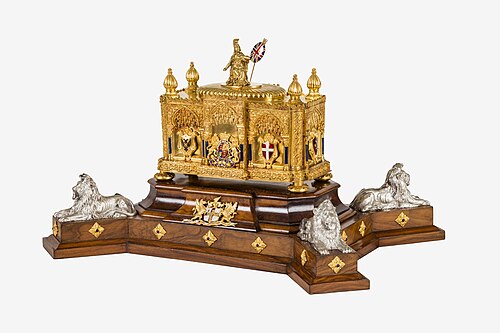
Casket of the Freedom of the City of London, presented to Benjamin Disraeli, housed at Hughenden. Dated 18th June 1878, the piece is decorated with multiple coats of Arms, including Disraeli's, as well as heraldic lions and lapis lazuli. Uploaded as part of this National Trust pilot https://en.wikipedia.org/wiki/Wikipedia:GLAM/National_Trust/Pilot_2
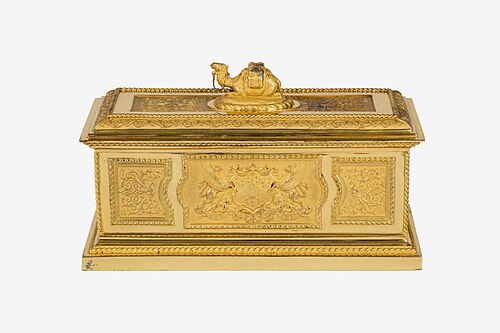
Ceremonial casket with camel on lid, given to Benjamin Disraeli at Hughenden by the Company of Grocers (unknown date). Uploaded by National Trust as part of https://en.wikipedia.org/wiki/Wikipedia:GLAM/National_Trust/Pilot_2
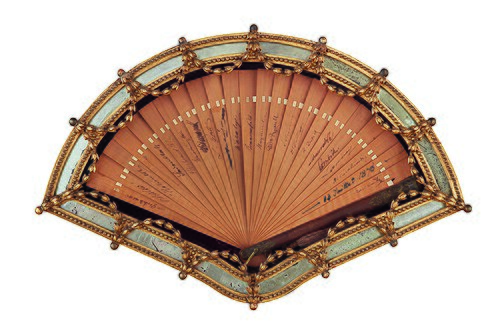
Fan signed by attendees of the Congress of Berlin on 18 July 1878, displayed at Disraeli's home, Hughenden Manor. Uploaded as part of this National Trust pilot https://en.wikipedia.org/wiki/Wikipedia:GLAM/National_Trust/Pilot_2
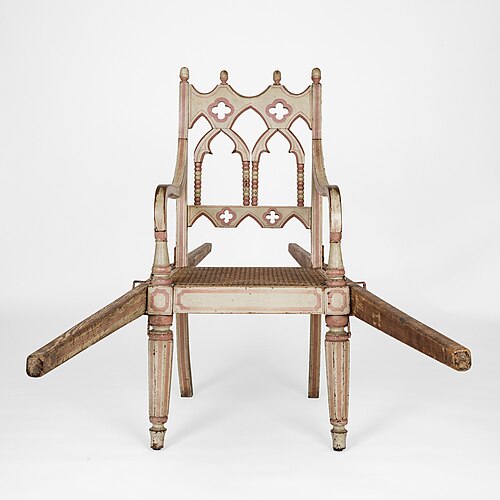
Sedan chair in pink and white made to carry Benjamin Disraeli in the event that he won the 1832 by-election. Unfortunately he did not, so the chair was not used for its electoral purpose. Hughenden, National Trust. Uploaded as part of this National Trust pilot https://en.wikipedia.org/wiki/Wikipedia:GLAM/National_Trust/Pilot_2

Scan of an editorial from Harper's Weekly that mentions Carl Schurz: “Change”, 1880-08-14, p. 514.

Garter encircled arms of Benjamin Disraeli, 1st Earl of Beaconsfield, KG, as displayed on his Order of the Garter stall plate in St. George's Chapel.