
Arthur C. Clarke
British science fiction writer, inventor, and futurist
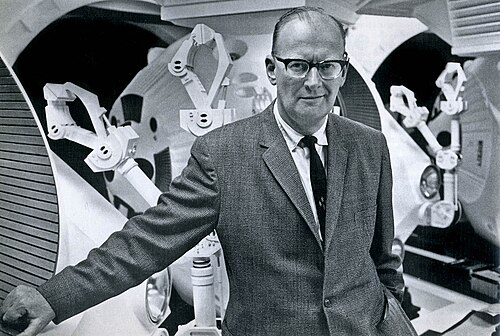
Photo by: ITU Pictures · CC BY 2.0 · Wikimedia Commons
Born:December 16, 1917
Died:March 19, 2008
Age at death:90
Manner of death:Natural Causes
Cause of death:Heart Failure
Zodiac Sign:Sagittarius
Born in:Minehead, United Kingdom
Residence:Sri Lanka, Sri Lanka
Buried in:Sri Lanka
Languages:English
Signature

Famous For
Notable Work
Movies & TV
Books
Awards
Arthur C. Clarke
British science fiction writer, inventor, and futurist
Biography
This biography uses content from the Wikipedia article “Arthur C. Clarke”, available under the Creative Commons Attribution-ShareAlike 4.0 License.
Quotes
“I can never look now at the Milky Way without wondering from which of those banked clouds of stars the emissaries are coming. If you will pardon so commonplace a simile, we have broken the glass of the fire-alarm and have nothing to do but to wait. I do not think we will have to wait for long”
— "The Sentinel" (1948), originally titled "Sentinel of Eternity".; This is the short story which later provided the fundamental ideas for 2001: A Space Odyssey (1968) written by Clarke and Stanley Kubrick. Full text in 10 Story Fantasy, Vol. 1, No. 1 (Spring 1951), p. 41. Two versions of the next to the last sentence have been widely published since at least 1951, the other being: "If you will pardon so commonplace a simile, we have set off the fire alarm and have nothing to do but to wait."
“If we have learned one thing from the history of invention and discovery, it is that, in the long run — and often in the short one — the most daring prophecies seem laughably conservative.”
— The Exploration of Space (1951), p. 111
“It is not easy to see how the more extreme forms of nationalism can long survive when men have seen the Earth in its true perspective as a single small globe against the stars.”
— The Exploration of Space (1951), p. 187
Quotes sourced from the Wikiquote article "Arthur C. Clarke", available under the Creative Commons Attribution-ShareAlike 4.0 License.
Photos
British science-fiction author Arthur C. Clarke in 1965
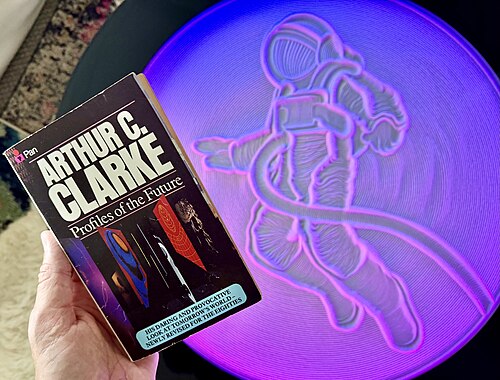
Prophesy from the year after the first human spaceflight: “In the long history of Man, ours is the first age with no new frontiers on land or sea, and many of our troubles stem from this fact.” (p.94) “The road to the stars has been discovered none too soon. Civilization cannot exist without new frontiers; it needs them both physically and spiritually. The physical need is obvious — new lands, new resources, new materials. The spiritual need is less apparent, but in the long run it is more important. We do not live by bread alone; we need adventure, variety, novelty, romance. What is true of individuals is also true of societies; they can become insane without sufficient stimulus.” (95) “Whatever the eventual outcome of our exploration of space, we can be reasonably certain of some immediate benefits — and I am deliberately ignoring such practical returns as the multi-billion dollar improvements in weather forecasting and communications, which may in themselves put space-travel on a paying basis. The creation of wealth is certainly not to be despised, but in the long run the only human activities really worthwhile are the search of knowledge, and the creation of beauty. This is beyond argument; the only point of debate is which comes first.” (99) “We have far from exhausted the Universe’s capacity for ingenious surprises.” (124) “The only way of discovering the limits of the possible is to venture a little way past them into the impossible” (36) “I will merely list, without going into detail, some of the services comsats will make possible… • Personal radio-telephones including such functions as position-finding, medical monitoring, police alert, search and rescue. • End of political censorship, when anything can be received and transmitted between all points on earth, with small, easily concealed equipment. • Global high-quality radio and TV networks, specializing in every conceivable subject. • Electronic mail transmission. • Global libraries, information banks (‘Video Brittanica’).” (204) On AI: Chapter 18 “The Obsolescence of Man” “The tool we have invented is our successor. Biological evolution has given way to a far more rapid process — technological evolution. To put it bluntly and brutally, the machine is going to take over.” (229) “This is one of the greatest — and perhaps one of the last — breakthroughs in the history of human thought. In the same way it took a little while for men to realize that machines can not only think, but may one day think them off the face of the Earth.” (230) “The first genuine thinking machines may be grown rather than constructed. There is the possibility of computers which will start from relatively simple beginnings, be programmed to aim at specific goals, and search for them by constructing their own circuits” (233) “A computer equivalent in power to one human brain need be no bigger than a matchbox.” (235) “It may well be that only in space… will intelligence be able to reach its fullest stature. In the ages to come, the dullards may remain on placid Earth, and real genius will flourish only in Space — the realm of the machine, not of flesh and blood.” (239) “There may be a brief Golden Age when men will glory in the power and range of their new partners. Barring war, this Age lies directly ahead of us. The extension of the human intellect by electronics will become our greatest occupation” (239) “One of the ways thinking machines will be able to help us is by taking over the humbler tasks of life, leaving the human brain free to concentrate on higher things… taking over all the minor chores like routine correspondence and income tax returns and engagement. On occasion it could even take its master’s place, keeping appointments he preferred to miss, and then reporting back in as much detail as he desired. It could substitute for him over the telephone so completely that no one would be able to tell if man or machine was speaking” (240) “But how long will this partnership last? Can the synthesis of Man and Machine ever be stable, or will the purely organic component become such a hindrance that it has to be discarded? If this eventually happens — and I have given good reasons for thinking that it must — we have nothing to regret and certainly nothing to fear.” (243) “No individual exists forever; why should we expect our species to be immortal? Man, says Nietzsche, is a rope stretched between the animal and the superman — a rope across the abyss. That will be a noble purpose to have served.” (243) And from his 1981 update: “Science will dominate the future even more than it dominates the present. Moreover, it is only in this field that prediction is at all possible; there are some general laws governing scientific extrapolation, as there are not in the case of politics or economics.” (9) “A critical — the adjective is important — reading of science fiction is essential training for anyone wishing to look more than ten years ahead. The facts of the future can hardly be imagined ab initio by those who are unfamiliar with the fantasies of the past.” (11) [Elon often credits inspiration to a sci-fi influence] “Almost 100% of reliable prophets will be science-fiction readers” (11) “Why has the future suddenly become respectable? There is certainly no simple or single explanation. It may be because most educated men have at last begun to understand the imperative of change, and the urgent need to prepare for the inevitable revolutions in almost every field of human activity. Having lived through several revolutions in half a lifetime makes it easier to accept the possibility that others are still to come.” (12) “The one fact about the Future of which we can be certain is that it will be utterly fantastic.” (14)

Arthur C. Clarke memorial plaque on the Chelsea Hotel building (New York City)
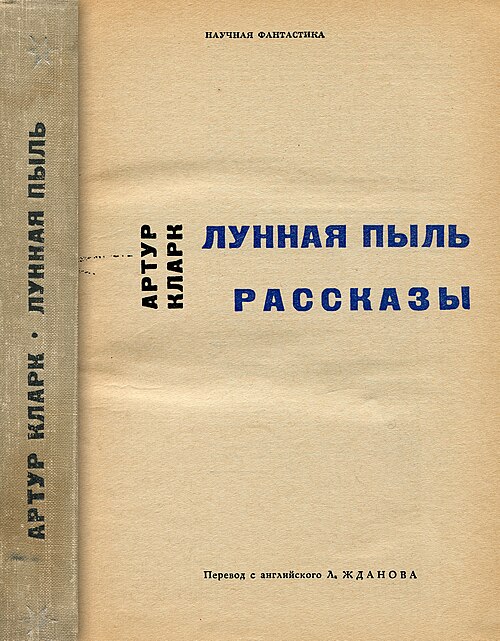
Arthur Charles. A Fall of Moondust
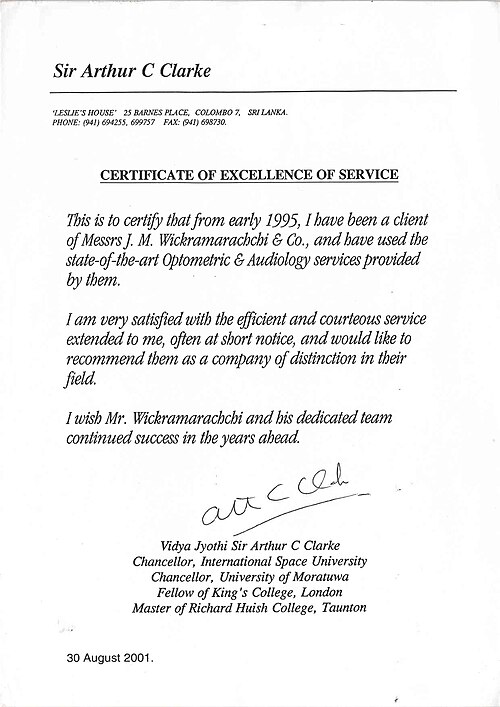
Certificate of Excellence of Service issued by Sir Arthur C. Clarke to J.M. Wickramarachchi & Company, dated 30 August 2001
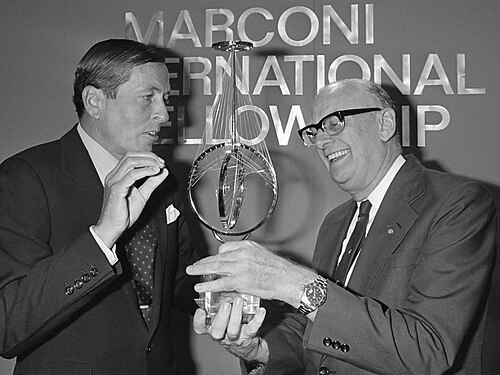
Prins Claus overhandigt Arthur C. Clarke de Marconi International Fellowship Award 1982 11 juni 1982
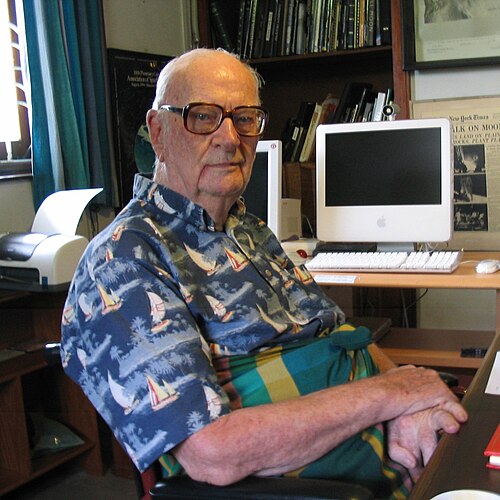
Sir Arthur C. Clarke at his home in Colombo, Sri Lanka. A visionary who predicted artificial intelligence and communications satellites that orbit the earth in fixed positions, Clarke characterizes the slow rebuilding process in the tsunami zone as "survival of the fittest." He enjoys listening to the media file of the wind of Titan, contemplates a future with "more people living off earth than on," who travel the "future homes of mankind" via space elevators. "Good wishes" he said this week, "to aspiring astronauts and cosmonauts" who will "go into space and look at the home planet."
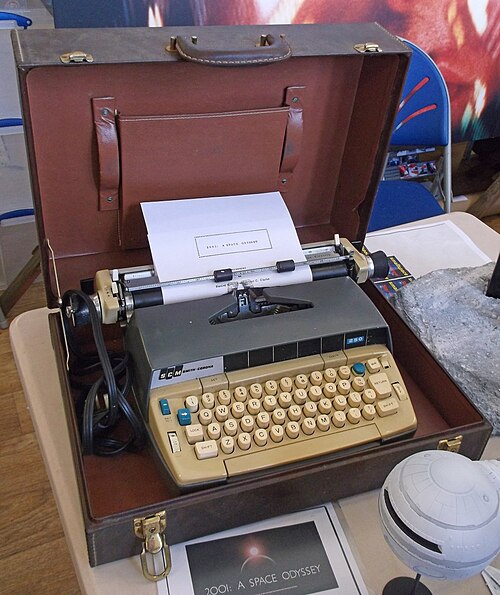
Arthur C Clarke typewriter

Cover of the first novel from the book series I Romanzi di Urania: The Sands of Mars by Arthur Clarke. Italy, 10th October 1952.

Arthur C. Clarke
Videos
Questions and answers about Arthur C. Clarke
Who was Arthur C. Clarke?
Arthur C. Clarke was a British science fiction writer, inventor, and futurist.
When was Arthur C. Clarke born?
Arthur C. Clarke was born on December 16, 1917.
When and how did Arthur C. Clarke die?
Arthur C. Clarke died on March 19, 2008, at the age of 90. Cause of death: heart failure.
Where was Arthur C. Clarke born?
Arthur C. Clarke was born in Minehead, United Kingdom.
What was Arthur C. Clarke known for?
Arthur C. Clarke was known for work as: novelist, inventor, science fiction writer, writer.