Victoria
Queen of the United Kingdom from 1837 to 1901
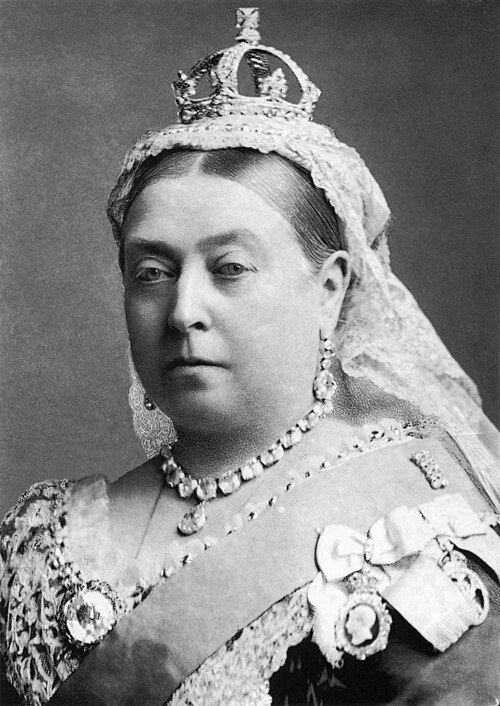
Photo by: Alexander Bassano · Public Domain · Wikimedia Commons
Born:May 24, 1819
Died:January 22, 1901
Age at death:81
Manner of death:Natural Causes
Cause of death:Cerebral Hemorrhage
Zodiac Sign:Gemini
Height:1.42 m (4′8″)
Children:9
Born in:Kensington Palace, United Kingdom
Residence:Kensington Palace, United Kingdom
Buried in:United Kingdom
Languages:Italian, German, Urdu, French, Latin, British English
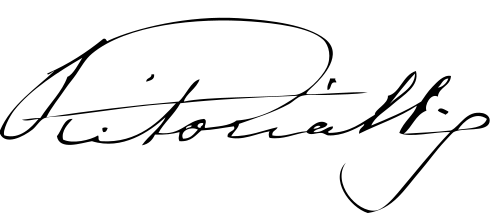
Signature
Related People
Photo credits (8)
- Victoria:
Photo by: Alexander Bassano · Public Domain · Wikimedia Commons
- Edward VII:
Photo by: Edward Poynter · Public Domain · Wikimedia Commons
- Wilhelm II:
Photo by: Rijksmuseum · CC0 · Wikimedia Commons
- George V:
Photo by: Bassano Ltd · Public Domain · Wikimedia Commons
- Nicholas II of Russia:
Photo by: Harris & Ewing Collection · Public Domain · Wikimedia Commons
- George III of Great Britain:
Photo by: Allan Ramsay · Public Domain · Wikimedia Commons
- George IV of the United Kingdom:
Photo by: Thomas Lawrence · Public Domain · Wikimedia Commons
- William IV:
Photo by: Martin Archer Shee · Public Domain · Wikimedia Commons
Famous For
Books
Awards
 Legion of Honour
 Grand Cross of the Legion of Honour
 Royal Order of Victoria and Albert
Victoria
Queen of the United Kingdom from 1837 to 1901
Biography
This biography uses content from the Wikipedia article “Victoria”, available under the Creative Commons Attribution-ShareAlike 4.0 License.
Quotes
“Affairs go on, and all will take some shape or other, but it keeps one in hot water all the time.”
— Letter to King of the Belgians, Nuneham, 15th June, 1841 (Note: Nuneham was the house of Edward Vernon Harcourt, Archbishop of York).
“My dearest Uncle,- I have the greatest pleasure in announcing to you a piece of news which I know will give you as much satisfaction and relief as it does to us, and will do to the whole of the world. Lord Palmerston is no longer Foreign Secretary—and Lord Granville has already named his successor!”
— Early Belgian colonial Efforts: The long and fateful shadow of Leopold I, Page 67 Victoria to Leopold, 23 December, 1851, in Benson, 2:345.
“It is worth being shot at to see how much one is loved.”
— After being shot at by Roderick Maclean on 2 March 1882, as quoted in Stanley Weintraub, Victoria. Biography of a queen (1987), p. 450.
Quotes sourced from the Wikiquote article "Victoria", available under the Creative Commons Attribution-ShareAlike 4.0 License.
Photos
Queen Victoria, 1819–1901, by Bassano, 1882. Glass copy negative, half-plate.
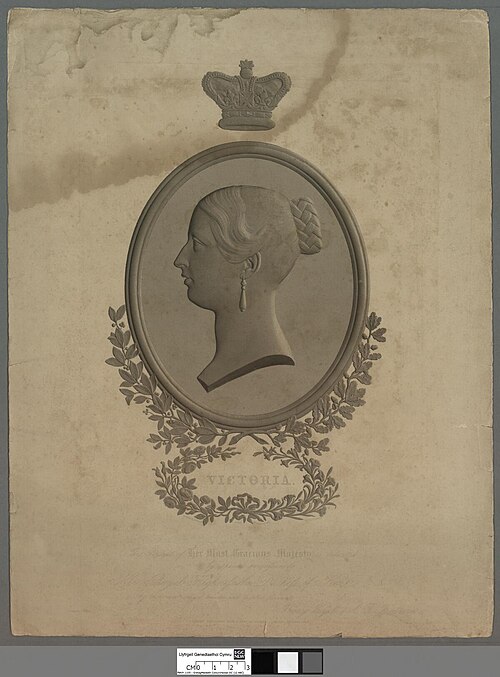
A portrait from the Welsh Portrait Collection at the National Library of Wales. Depicted person: Victoria – Queen of the United Kingdom from 1837 to 1901 (1819-1901)
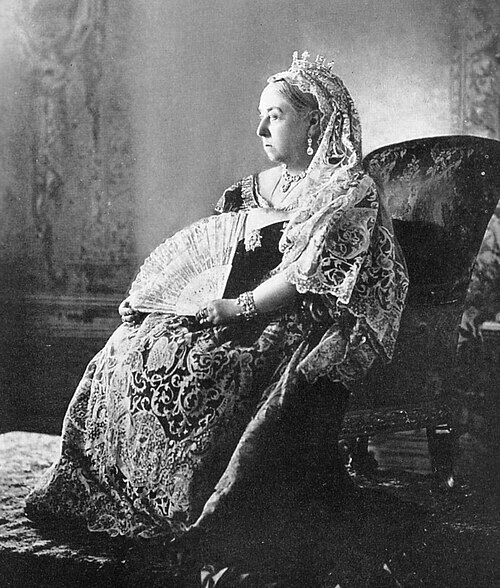
Photo of Queen Victoria of the United Kingdom / Empress Victoria of India, London, 1897.

'The Royal Windsor Pear changing to her most Gracious Majesty Queen Victoria & her Royal Consort Albert of Saxe Cobourg & Gotha.'
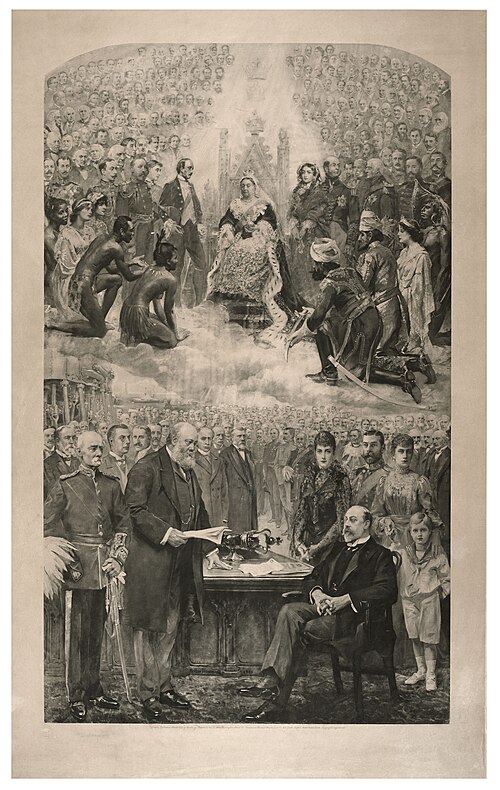
In 24 May 1903, Empire Day was first celebrated in New Zealand. Now known as ‘a forgotten anniversary’, the day was observed every year on the birthday of Queen Victoria. The day had 'the double purpose of keeping fresh and green the memory of a most illustrious reign and rejoicing in the consolidation of our great Empire.' Parades and ceremonies were a feature, and children were especially targeted with imperial messages. Empire Day was celebrated until the 1950s when, as nzhistory.net.nz notes, ‘Empire Day segued into Commonwealth Day in 1958.’ This is a large-format print of an oil painting by Arthur Drummond, called ‘The Assumption of Queen Victoria’, 1901. It was painted to mark the accession of Edward VII in 1901, following the death of Queen Victoria. Drummond depicts Victoria as having ascended into heaven, who is surrounded by stereotypes of the indigenous peoples colonised by the British Empire. Kneeling are depictions of two Indian maharajahs and a Zulu warrior, while the white female figures could be said to represent colonies such as Canada, Australia and New Zealand. The people are all real-life figures that had passed away by 1901. Below Victoria are real-life figures from 1901 - each person is based on someone living at that time. New Zealand's Premier, Richard Seddon ('King Dick'), is pictured directly behind the mace of the House of Commons (sitting on teh desk). It is an example of the imperialist hagiography common at that time. More information on the work can be found at catalogue.wellcomelibrary.org/record=b1575624 Archives Reference: unlisted (possibly from the 'WHAT' agency) Material from Archives New Zealand Caption information from www.nzhistory.net.nz/politics/empire-day
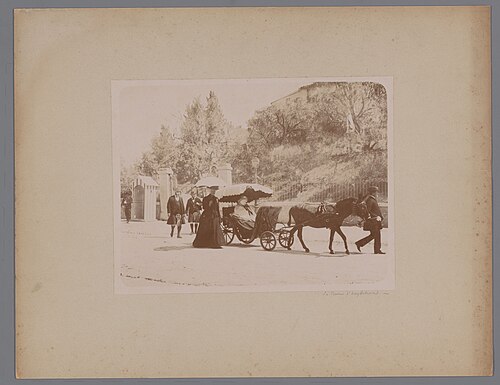
Identificatie Titel(s): Koningin Victoria in haar rijtuig in een park, Frankrijk [?] Objecttype: foto Objectnummer: RP-F-00-6398 Opschriften / Merken: signatuur, recto links, in negatief geschreven: ‘[...] COUTON//NICE’, eerste woord/naam [?] zeer slecht leesbaaronderschrift, recto rechtsonder, La Reine d'Angleterre Omschrijving: Koningin Victoria in haar rijtuig in een park, met personeel en twee gardes. Vervaardiging Vervaardiger: fotograaf: Claudius Couton (vermeld op object) Plaats vervaardiging: Nice Datering: ca. 1890 - 22-jan-1901 Fysieke kenmerken: daglichtgelatinezilverdruk op fotopapier op karton Materiaal: fotodrager karton Techniek: daglichtgelatinezilverdruk Afmetingen: foto: hoogte 175 mm (Afgeronde hoeken.) × breedte 229 mm, karton: hoogte 303 mm × breedte 388 mm Verwerving en rechten Credit line: Schenking van de heer W. Diepraam, Amsterdam Verwerving: schenking 1996 Copyright: Publiek domein
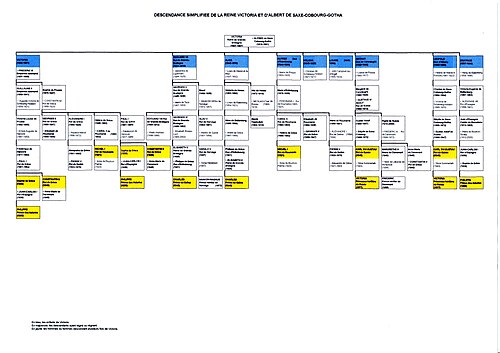
Simplified genealogy of Queen Victoria's descendants, members of royal families

Queen Victoria surrounded by her entire family, that reigned across the entire Europe. It is a royal family group photograph at Coburg, into the Palais Edinburgh, following the wedding of Princess Victoria Melita of Saxe-Coburg and Gotha, and Grand Duke Ernest of Hesse, 21 April 1894. (The wedding took place two days before, on 19 April 1894) The following people are in the photo from left to right: 1. Kaiser Wilhelm II. Son of No. 3. 2. Queen Victoria. 3. Victoria, the Empress Frederick, was the eldest child of Queen Victoria. She married Crown Prince Frederick William of Prussia who was briefly Kaiser Frederick III. 4. Princess Beatrice of Edinburg and of Saxe-Coburg-Gotha, 10-year-old in this picture, was the younger sister of the bride. She later married Alfonso, the Infante of Spain. 5. 15-year-old Feodora was Queen Victoria's first great-grandchild, having born into Bernard III, Duke of SaxeMeiningen and Charlotte (No. 15). She was their only child, and committed suicde in 1945 after a lifetime of illhealth. 6. 20-year-old Alfred had just recently become the Heir Apparent to the Duchy of Saxe-Coburg-Gotha in 1894. He is brother of the bride. Suicidal and syphilitic, he died under murky circumstances in 1899. 7. Albert Edward, Prince of Wales, would ascend to the British Throne in 1901. He always distrusted his eldest nephew, the Kaiser. 8. Tsarevitch Nicholas (soon-to-be Nicholas II) was at the wedding to announce his engagement to No.9. His parents wanted a dynastic union with France, but finally relented to his wishes. 9. Alix of Hesse was the daughter of Grand Duke Louis IV of Hesse and by Rhine, and Princess Alice -- the second daughter of Queen Victoria. Before the year was out, she would be Empress of All Russias. 10. Victoria of Battenberg was the elder sister of No. 9. She married her father's first cousin Prince Louis of Battenberg (No.21). 11. Irene of Hesse married her first cousin Prince Henry of Prussia, the popular younger brother of the Kaiser. No. 9, 10, 11 are all sisters of the groom. 12. Marie of Mecklenburg-Schwerin was the wife of Grand Duke Vladimir of Russia and was known as the grandest of the grand duchesses. Her husband being the brother of No. 13, she was the bride's aunt. 13. The bride's mother, Duchess Marie of Edinburgh and Saxe-Coburg, was born Grand Duchess Maria Alexandrovna of Russia, the only surviving daughter of Tsar Alexander II. During the WWI, the Dowager Duchess was maintained as a prisoner of state. 14. Princess Alexandra of Edinburgh and of Coburg-Gotha, was the sister of the bride. Two years later, she married a distant cousin, Prince Ernst HohenloheLangenberg. 15. Charlotte of Saxe Meiningen, mother of No. 5, was a daughter of Kaiser and Kaiserin Frederick of Germany (No. 3). She shared confrontational and conservative politics of her brother Kaiser Wilhelm II. 16. & 17. The Duchess of Connaught was born Princess Louise Margaret of Prussia. Her granduncle was Kaiser Wilhelm I. Arthur, the Duke of Connaught and Strathearn was the seventh child of Queen Victoria. Later, he was appointed the Governor General of Canada. 18. & 19. Beatrice, the youngest of Queen Victoria's daughters, married Henry of Battenberg, the younger brother of Louis of Battenberg (No. 21). The prince photographed here in military attire, lost his life during the Ashanti War. 20. Princess Louise Marie of Belgium married Phillip of Saxe-Coburg and Gotha-Kohary (No. 23) against the wishes of her father, Leopold II of Belgium, who viewed it as an unwelcome alliance with Prussia. Three years after this photo, she left her husband for an Austrian lieutenant. Heavily indebted and mentally unstable, she later became an outcast, and barred from every court in Europe. 21. Admiral Prince Louis of Battenberg, husband of No. 10, brother of No. 19, later became the First Sea Lord and changed his titles to that of Marquess of Milford Haven after the First World War. 22. The bride's maternal uncle Grand Duke Paul was later arrested and shot by the Bolsheviks in 1919. 23. Prince Philip of Coburg-Kohary, husband of No. 18, was the elder brother of Ferdinand, who became the Tsar of Bulgaria in 1887. 24. Alfons Mensdorff-Pouilly had only a few more months to live after this photo. The count, whose mother was Princess Sophie of Saxe-Coburg-Saafeld, was a cousin of both Queen Victoria and Prince Albert. He was a General of Cavalry in the Austrian Army. 25. The bride's another maternal uncle Grand Duke Sergei, the then Governor General of Moscow. His wife was also a Hesse (No. 28). An extreme reactionary, he was assassinated in 1905. 26. & 27. Marie of Edinburgh was the elder sister of the bride. Only the previous year, she had married the Crown Prince Ferdinand of Romania. They became King and Queen in 1914. 28. Elizabeth was the eldest sister of the groom, and of No. 9, 10, 11. A decade before her sister married Tsar Nicholas II, she married No. 25, becoming Grand Duchess Sergei of Russia. 29. Yet another maternal uncle of the bride, Vladimir of Russia (brother of No. 13, husband of No.12) was the senior Grand Duke of the House of Romanov. His son, Cyril, would later become the second husband of the bride. 30. Alfred, Duke of Edinburgh, was the second son of Queen Victoria. Less than a year earlier, he had succeeded his paternal uncle Ernst II as the Duke of Saxe-Coburg-Gotha. He is father of the bride and of No. 4, 6, 14, 27 and husband of No. 13.
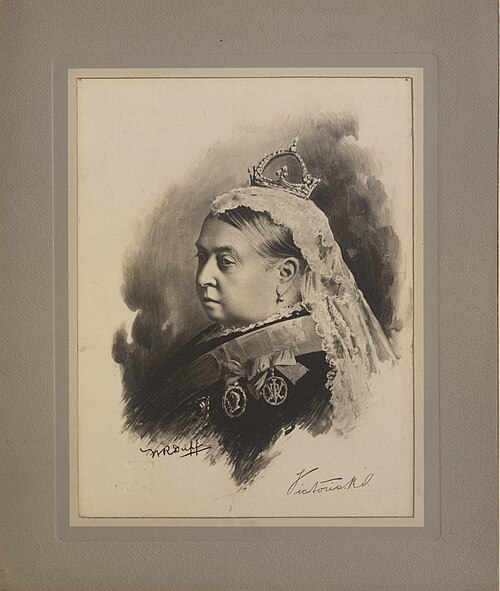
Her Late Majesty Queen Victoria [photo-lithograph].
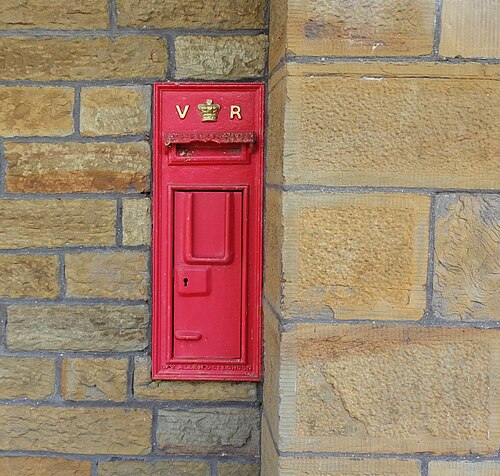
Pantyffynnon railway station, Heart of Wales Line, Carmarthenshire. Queen Victoria letterbox.
Videos
Questions and answers about Victoria
Who was Victoria?
Victoria was a Queen of the United Kingdom from 1837 to 1901.
When was Victoria born?
Victoria was born on May 24, 1819.
When and how did Victoria die?
Victoria died on January 22, 1901, at the age of 81. Cause of death: cerebral hemorrhage.
Where was Victoria born?
Victoria was born in Kensington Palace, United Kingdom.
What was Victoria known for?
Victoria was known for work as: monarch, writer, painter, diarist.
How tall was Victoria?
Victoria was 1.42 m (4 ft 8 in) tall.
Who was Victoria connected to?
Victoria was connected to: Edward VII, Wilhelm II, George V, Nicholas II of Russia, George III of Great Britain.