סטיבי ריי וון
גיטריסט בלוז ורוק אמריקני
נולד:אוקטובר 3, 1954
נפטר:אוגוסט 27, 1990
גיל בפטירה:35
צורת המוות:מוות בשוגג
סיבת המוות:אסון תעופה
מזל:מאזניים
נולד ב:דאלאס, ארצות הברית
מקום קבורה:ארצות הברית
שפות:אנגלית
חתימה

ידוע בזכות
להקות
שירים ואלבומים
פרסים
 פרס גראמי
סטיבי ריי וון
גיטריסט בלוז ורוק אמריקני
ביוגרפיה
ביוגרפיה זו משתמשת בתוכן מתוך ערך הוויקיפדיה “סטיבי ריי וון”, הזמין תחת רישיון Creative Commons Attribution-ShareAlike 4.0.
תמונות
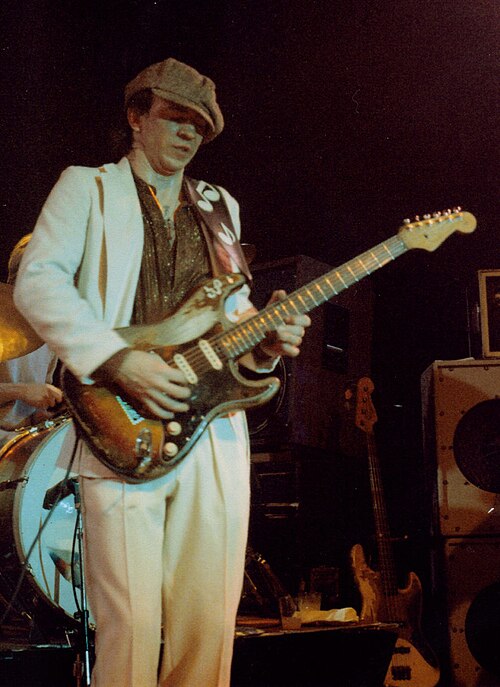
Stevie Ray Vaughan & Double Trouble Played the Ritz Theater in Austin, Texas on March 18th & 19th 1983.

Rumble Seat Music Vintage Guitars - Carmel, CA
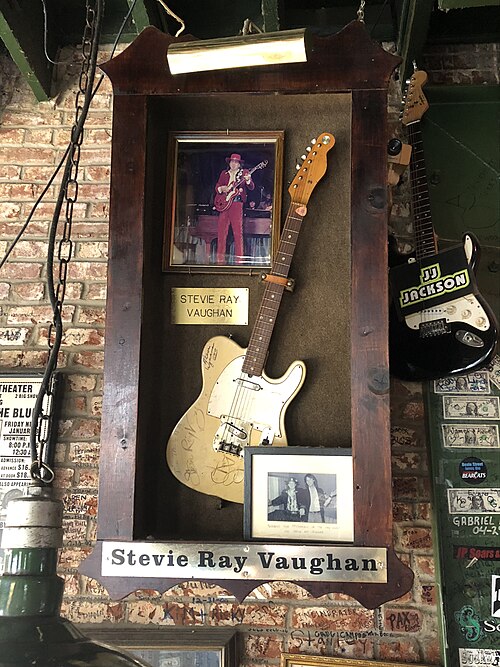
Beale Street in Memphis, Tennessee

Number One Jimmy Page's primary guitar from 1969 onward. Previously owned by Joe Walsh. [front] Jimmy Paeg's "Number One" ca.1959-1960 Gibson Les Paul Standard - Play It Loud. MET (2019-05-13 18.43.02 by Eden, Janine and Jim) "Number One" Les Paul Standard (ca.1959-60), Gibson. Play It Loud: Instruments of Rock & Roll. Metropolitan Museum of Art.. " Jimmy Page purchased this instrument in 1969 from Joe Walsh, who was in the band James Gang at the time and later became a member of the Eagles. When Page received it, the neck had already been shaved down to a thinner profile. It has been Page's main guitar throughout his career, used in every Led Zeppelin performance and recording from 1969 to the 2007 reunion and in his post-Zeppelin work with the Firm and others. It remains in active use today as his primary guitar. " "Technical Description: Mahogany body and neck, carved maple top, rosewood fingerboard; 24¾ in. scale; sunburst finish with cream binding; set neck with pearloid trapezoid inlays and cream binding; mother-of-pearl Gibson headstock logo and gold silkscreened “Les Paul” signature; two PAF humbucking pickups, three-way selector switch, two volume and two tone controls; nickel-plated ABR-1 tune-o-matic bridge and pickup covers, gold-plated Grover Rotomatic tuners, clear and gold plastic knobs, cream plastic pickguard; Neck shaved to thinner profile, push-pull pickup phase switch added, bridge pickup cover removed, tuners replaced ", "Object Details: ", "Title: "Number One" Les Paul Standard ", "Artist: Gibson (American, founded Kalamazoo, Michigan 1902) ", "Artist: Jimmy Page (British, Heston, born 1944) ", "Date: ca. 1959-60 ", "Medium: Mahogany, maple, rosewood, nickel, plastic, mother-of-pearl ", "Dimensions: Length: 39 1/4 in. (99.7 cm) / Width: 13 in. (33 cm) / Depth: 2 in. (5.1 cm) / Weight: 9-10 lbs. (4.1 - 4.5 kg) ", "Classification: Chordophone-Lute-plucked-fretted ", "Credit Line: Collection of Jimmy Page ", "Provenance: Joe Walsh; Jimmy Page, 1969 " [left] Stevie Ray Vaughan's "Number One" composite Fender Stratocaster (1963 body, 1962 neck, 1959 pickups) from Ray Hennig’s Heart of Texas music store in 1974, modified with black pickguard featuring his initial - Play It Loud. MET (2019-05-13 by Eden, Janine and Jim) "Number One" composite Stratocaster (ca. 1963), Fender. Play It Loud: Instruments of Rock & Roll. Metropolitan Museum of Art. " Stevie Ray Vaughan, one of the key drivers of the 1980s blues revival, used “Number One” as his main instrument throughout his career. Vaughan acquired the Stratocaster, built from a 1963 body with a 1962 neck and 1959 pickups, from Ray Hennig’s Heart of Texas music store in 1974 and modified it with a black pickguard featuring his initials. Inspired by Jimi Hendrix and Otis Rush, Vaughan added a lefty vibrato. Vaughan played this guitar on his albums with Double Trouble and with his brother Jimmie Vaughan, and he likely used it on David Bowie’s Let’s Dance in 1982, made after the two met at the Montreux Jazz Festival. " "Technical Description: Contoured alder body, maple neck, rosewood fingerboard; 25½ in. scale; sunburst finish; bolt-on neck with dot inlays; gold “spaghetti” Fender logo decal on headstock; three single coil pickups, three-way pickup selector, one volume and two tone controls; gold-plated left handed vibrato system, Schaller tuners; constructed from 1963 body, 1962 neck, 1959 pickups, vibrato replaced, black pickguard with SRV initials, all chrome hardware replaced with gold, “custom” decal at bridge, cigarette burn on headstock ", "Artwork Details: ", "Title: "Number One" composite Stratocaster ", "Artist: Fender ", "Artist: Stevie Ray Vaughan ", "Date: ca. 1963 ", "Medium: Alder, maple, walnut, rosewood, metal, plastic ", "Dimensions: Length: 39 3/4 in. (101 cm.) / Width: 12 3/4 in. (32.4 cm.) / Depth: 1 3/4 in. (4.4 cm.) / Weight: 7-8 lbs. ", "Classification: Chordophone-Lute-plucked-fretted ", "Credit Line: Courtesy of The Estate of Stevie Ray Vaughan ", "Provenance: Formerly owned by singer-songwriter Christopher Cross, acquired by Stevie Ray Vaughan in 1974, Ray Hennig’s Heart of Texas Music. Jimmie Vaughan has been the owner since SRV's death in 1990. " [right] Jerry Garcia's "Wolf" (1973-1979) by Doug Irwin - Play It Loud. MET (2019-05-13 by Eden, Janine and Jim) "Tiger" (1973-1979), Doug Irwin. Play It Loud: Instruments of Rock & Roll. Metropolitan Museum of Art. " Immediately after receiving the “Wolf” guitar from Doug Irwin in 1973, Jerry Garcia commissioned “Tiger,” telling Irwin to make the most extravagant instrument he was capable of. The instrument—composed of highly figured exotic woods that are sandwiched and laminated together and embellished with ornate brass bindings and the inlay of a tiger—took Irwin about two thousand hours of work to complete over six years. Garcia first played “Tiger” on August 4, 1979, at the Oakland Civic Auditorium, and he used it almost exclusively until 1989. It was the last guitar Garcia played publicly with the Grateful Dead, at a performance on July 9, 1995. " "Technical Description: Cocobolo top and back, sandwiched maple and padauk core, quilted maple on back, three-piece flame maple and padauk neck with brass binding; ebony fingerboard; 25 in. scale; natural finish with brass binding; neck through body with mother-of-pearl inlays, “J. GARCIA” inlaid at end of fingerboard, and brass binding; brass-bound headstock with mother-of-pearl globe and ivory eagle logo; mother-of-pearl tiger inlay framed in ebony and brass on front of body, brass-bound quilted maple circle with mother-of-pearl vegetal inlay and marquetry on back; two humbucking pickups and one single-coil, five-way selector switch, two volume controls and one tone control, two coil tap switches, effects loop output and on/off switch, unity-gain buffer; brass pickup mounting bracket, bridge, tailpiece, tuners, knobs and control surfaces ", "Artwork Details: ", "Title: "Tiger" ", "Artist: Doug Irwin ", "Artist: Jerome John "Jerry" Garcia (American, San Francisco, California 1942–1995 Forest Knolls, California) ", "Date: 1973-1979 ", "Medium: Cocobolo, maple, ebony, padauk, ivory, brass, vermillion, mother-of-pearl ", "Dimensions: Length: 40 in. (101.6 cm) / Width: 12 7/8 in. (32.7 cm) / Depth: 1 3/4 in. (4.4 cm) / Weight: ~14 lbs ", "Classification: Chordophone-Lute-plucked-fretted ", "Credit Line: Courtesy of Jim Irsay "
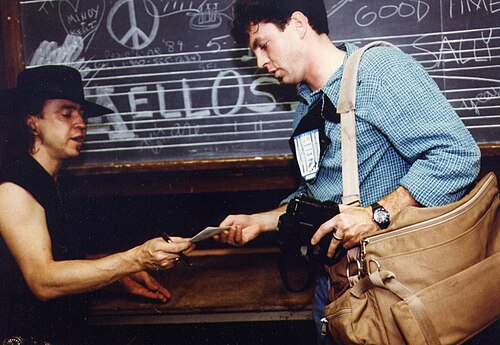
Stevie Ray Vaughan signing an autograph for a fan after Double Trouble's show in Minneapolis, MN on October 25, 1989 on their In Step Tour
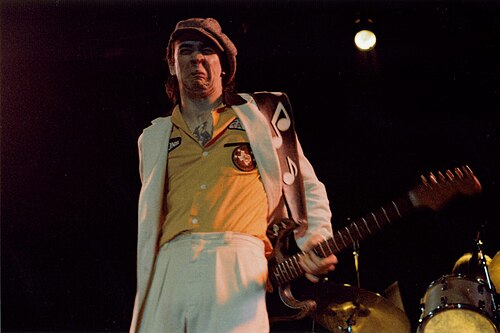
Stevie Ray Vaughan & Double Trouble played the Ritz Theater in Austin, Texas on March 18th & 19th, 1983. Stevie loved to play behind his back and as a photographer, that just gave me an better opportunity to take some great shots as he made some interesting faces.
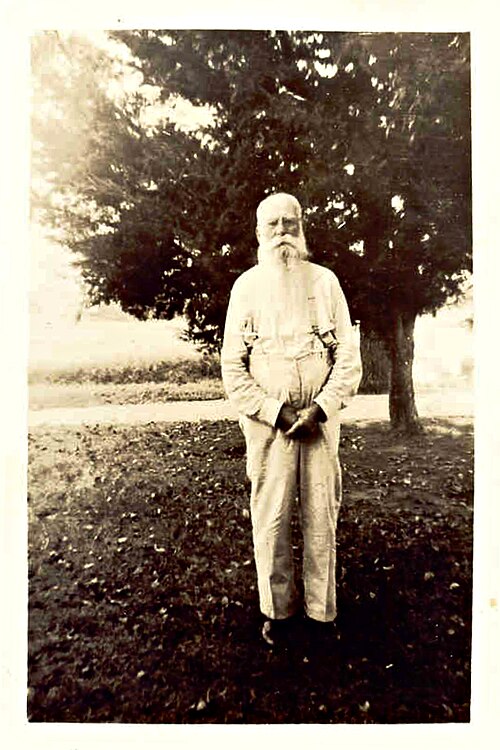
Stevie Ray Vaughan's paternal great-grandfather
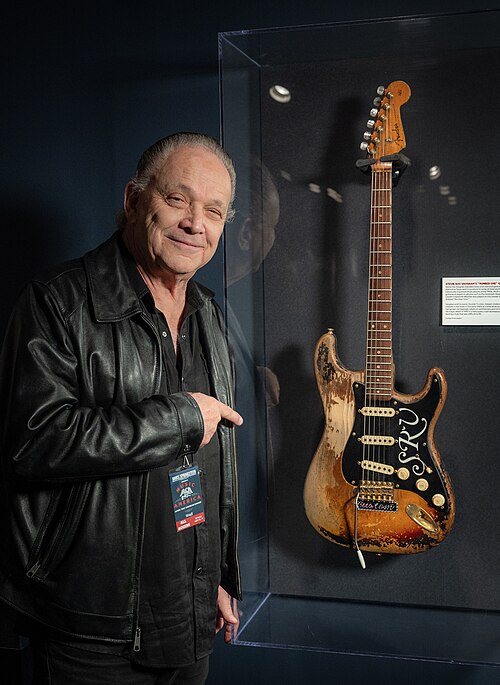
Jimmie Vaughan points to the guitar played by his brother, Stevie Ray Vaughan, on display in the Music America exhibit at the LBJ Library. On Feb. 15, 2024 the LBJ Presidential Library partnered with the Bruce Springsteen Archives & Center for American Music to host a concert to open a new exhibit, Music America: Iconic Objects from America’s Music History. The musicians included Alejandro Escovedo, Ruthie Foster, Jimmie Dale Gilmore, Colin Gilmore, Lyle Lovett, Jimmie Vaughan And The Tilt-A-Whirl Band, and Erika Wennerstrom with Bob Santelli serving as emcee. LBJ Library photo by Jay Godwin 02/15/2024 Quotation STEVIE RAY VAUGHAN “NUMBER ONE” GUITAR Stevie Ray Vaughan blended blues and rock and gave in ... distinctive Teras twist to produce to some of most excit... historically important blues albums ... of the 1980s. Most of ... guitarwork heard on albums such as the landmark Texas ... Couldn't Stand the Weather was played on this Fender Stratocaster dobbed “Number One”. Vaughan and his band, Double Trouble, helped create a ... interest in the blues in the early 1980s at a time when po... had grown increasingly relevant on synthesizers and drum ... His tragic death in 1990 in a helicopter crash stunned p... leaving a hole that man difficult to fill. Courtesy Jimmie Vaughan (?)
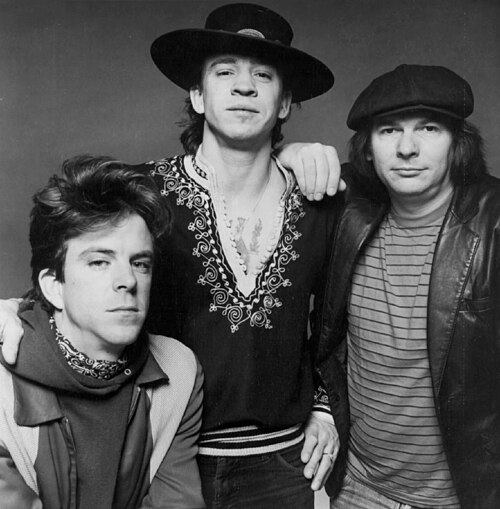
Publicity photo of the original line-up of American blues-rock band Double Trouble, circa 1983. From left to right: Chris Layton, Stevie Ray Vaughan, and Tommy Shannon.
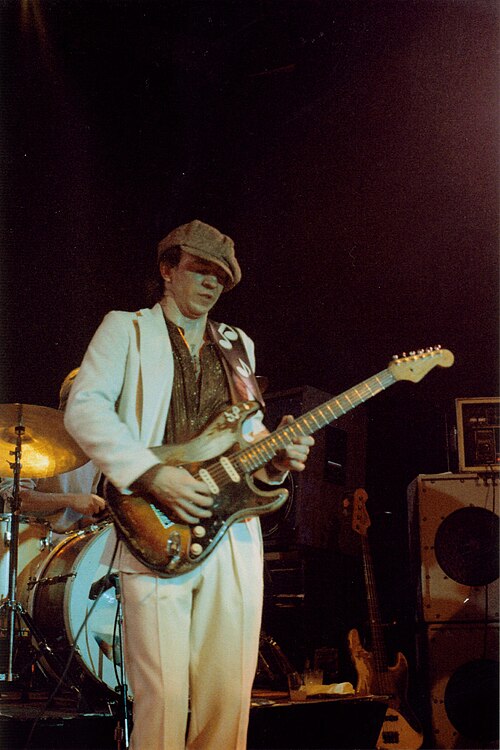
Stevie Ray Vaughan & Double Trouble Played the Ritz Theater in Austin, Texas on March 18th & 19th 1983.